%20(1640%20x%20650%20px)%20(1640%20x%20500%20px).png)
The Arctic Mirage: Why a Ukraine Peace Deal Won’t Save ASEAN from the “Mineral Iron Curtain”
Southeast Asia’s policy class is watching the wrong theatre. While a potential Ukraine ceasefire might shift European headlines and trim near-term risk premiums, it will not unwind the structural forces now shaping ASEAN’s energy reality.
The region is not merely being squeezed by a single conflict; it is being caught in a new coupling where critical minerals are being securitised at the top of the supply chain while LNG is being fundamentally repriced at the bottom through financeability, sanctions exposure, and compliance frictions.
This is the core of what the region’s “peace dividend” advocates consistently miss: even if the battlefield quiets, the global market architecture does not revert.
The Greenland Gambit and the New Resource Apartheid
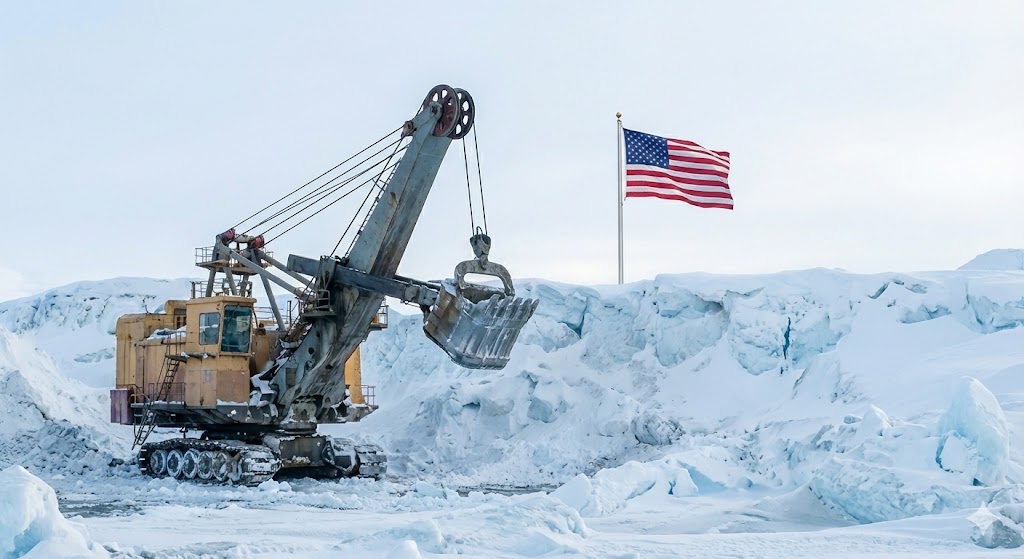
This shift is less about traditional mining and more about the emerging control of the energy transition’s strategic choke points. Washington’s drive to backstop non-China rare earth supply chains has evolved from rhetoric into direct sovereign financing. A primary example is the Export-Import Bank of the United States (EXIM) issuing a Letter of Interest for up to $120 million to support the Tanbreez rare earth project in Southern Greenland.
This funding, framed under the Supply Chain Resiliency Initiative, represents a mission-critical effort to counter China’s continued dominance in the sector.
Yet, Greenland also illustrates the real constraints of this strategy. Marquee deposits like Kvanefjeld remain mired in domestic restrictions and legal disputes, highlighting that simply identifying ore bodies is not a replacement for a functioning industrial strategy.
Downplaying the US’ interest in Greenland’s rare earth, Energy Secretary Chris Wright recently said it’s expensive to mine in a remote territory with not a lot of infrastructure and lots of ice. “There’re certainly far more attractive places to mine for rare earths. We’ve got all sorts of places to mine rare earth metals and produce oil and gas,” Wright said.
For ASEAN, the risk is structural. In a world where critical-mineral supply chains are reorganized around security alliances, or “club goods”, rather than open market allocations, the constraint on ASEAN is not geology — it’s bankability and compliance.
As Western powers move toward "club goods", the upstream bottleneck in rare-earth processing remains firmly in Chinese hands. If access to mission-critical processed minerals such as neodymium and dysprosium remains politicised, ASEAN’s renewable buildout will slow — not due to lack of ambition, but because essential inputs become more difficult to finance and source. ASEAN can import wind turbines, EV motors, and grid-scale storage systems. But many of these technologies depend on high-performance permanent magnets—typically NdFeB (neodymium–iron–boron)—and heavy rare earths such as dysprosium to maintain heat tolerance.
Mining is geographically diversified but processing is not. China now dominates chemical separation, oxide refining, metal/alloy production and magnet fabrication. Hence, the binding constraint lies midstream, at the processing stage where policy risk can be applied most effectively.
“Club Goods” logic disrupts financing when Western economies shift toward trusted supplier frameworks, export-control regimes and origin-traceability requirements. They effectively convert processed rare earths into compliance-conditioned inputs. This creates financing friction and a sanctions/export-control risk premium, if project inputs originate from geopolitically exposed processors, or transit via entities on watchlists.
As such, commercial banks, export-credit agencies and project-finance lenders may classify renewable projects as supply-chain-disruption risks. This would trigger higher interest margins, tighter loan covenants and/or outright credit withdrawal for wind, EV, and grid-modernization projects reliant on those materials.
In this scenario, natural gas does not fade; it becomes the default bridge fuel for far longer than planned.
The “Zombie Peace” and the Bifurcation of LNG
A ceasefire may soften market sentiment, but it cannot resurrect the broken trust or the physical infrastructure of the pre-2022 era. Europe’s structural pivot is already complete, with the United States supplying 60% of the European Union's LNG in January 2026, up from 53% a year earlier. But the EU has further committed to a total ban on Russian LNG and pipeline gas imports by late 2027, ensuring that even a "Zombie Peace" will not restore old flows.
Consequently, the global LNG market is splitting into two practical tiers. On one side sits "Bankable" LNG — cargoes that clear mainstream insurance, shipping, and trade finance with minimal friction. On the other sits "Finance-fragile" LNG, or "grey gas," which may exist physically in the Arctic but becomes commercially radioactive as enforcement regimes move toward ecosystem friction rather than just entity-based sanctions. This is particularly relevant as Russia utilizes shadow fleets and transshipment schemes to bypass restrictions. In 2026, LNG is priced as much in documentation certainty and service access asit is in dollars per million BTU.
The Financeability Trap and Cost of Neutrality
ASEAN’s core risk is not a physical lack of gas, but the loss of the ability to buy it cleanly and at scale.
This pressure is compounded by a massive regional demand shock. Forecasts indicate that Southeast Asia’s data-centre power demand could quadruple from roughly 2.6 GW in 2025 to 10.7 GW by 2035, potentially accounting for 10% of total demand in hubs like Malaysia and Singapore. This inelastic load requires more fuel and infrastructure, forcing deeper interaction with global compliance regimes.
The "Mineral-for-Gas" trade-off is becoming a permanent line item. Delays in clean inputs from securitised mineral chains extend gas dependence, while sanctions creep turns discounted supply into a trade-finance trap.
ASEAN’s historic preference for flexible alignment is becoming prohibitively expensive as energy procurement is instrumented through the financial system. A Ukraine ceasefire will not unwind these architectures; rather, it may create a false sense of security while the new compliance and supply-chain barriers continue to harden.
The only durable path forward for the region is securing its own processing and downstream capacity before Arctic and Atlantic supply chains become effectively club-gated.
Analysis by Penaga Research & Consultancy: Helping business, institutions & public bodies navigate today’s rapidly shifting world through sharp analyses, strategic communications and trusted advisory.


.svg)